How to Know the Concentration of a Solution You Are Making
Dilutions of Solutions
Diluting a solution involves adding additional solvent to decrease the solution'south concentration.
Learning Objectives
Calculate the concentration of a diluted solution.
Cardinal Takeaways
Cardinal Points
- Most commonly, a solution 's concentration is expressed in terms of mass percent, mole fraction, molarity, molality, and normality. When calculating dilution factors, it is important that the units of volume and concentration remain consistent.
- Dilution calculations tin can be performed using the formula 10001Vi = Thousand252.
- A series dilution is a series of stepwise dilutions, where the dilution factor is held constant at each footstep.
Key Terms
- dilution: a solution that has had additional solvent, such every bit water, added to make information technology less concentrated
- serial dilution: stepwise dilution of a substance in solution
Dilution refers to the process of adding boosted solvent to a solution to subtract its concentration. This process keeps the amount of solute abiding, but increases the total amount of solution, thereby decreasing its final concentration. Dilution can likewise be achieved past mixing a solution of higher concentration with an identical solution of lesser concentration. Diluting solutions is a necessary process in the laboratory, as stock solutions are often purchased and stored in very concentrated forms. For the solutions to be usable in the lab (for a titration, for case), they must be accurately diluted to a known, lesser concentration.
The volume of solvent needed to fix the desired concentration of a new, diluted solution can exist calculated mathematically. The relationship is as follows:
[latex]\text{Chiliad}_1\text{Five}_1=\text{M}_2\text{V}_2[/latex]
Mane denotes the concentration of the original solution, and V1 denotes the volume of the original solution; Thousand2 represents the concentration of the diluted solution, and V2 represents the final volume of the diluted solution. When calculating dilution factors, it is important that the units for both volume and concentration are the aforementioned for both sides of the equation.
Instance
- 175 mL of a i.vi Thou aqueous solution of LiCl is diluted with water to a final volume of 1.0 Fifty. What is the final concentration of the diluted solution?
- [latex]\text{M}_1\text{V}_1=\text{M}_2\text{Five}_2[/latex]
- (1.6 G)(175 mL) = Thousand 2(1000 mL)
- G 2 = 0.28 Thousand
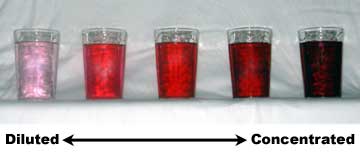
Dilutions: Dilutions can sometimes be visually observed. In the paradigm above, the intense ruby-red colour slowly fades as the solutions become more diluted.
Series Dilutions
Serial dilutions involve diluting a stock or standard solution multiple times in a row. Typically, the dilution factor remains constant for each dilution, resulting in an exponential subtract in concentration. For case, a ten-fold series dilution could result in the following concentrations: i Thou, 0.1 Chiliad, 0.01 M, 0.001 One thousand, then on. As is evidenced in this example, the concentration is reduced past a factor of 10 in each step. Serial dilutions are used to accurately create extremely diluted solutions, as well as solutions for experiments that require a concentration bend with an exponential or logarithmic calibration. Series dilutions are widely used in experimental sciences, including biochemistry, pharmacology, microbiology, and physics.
Using Molarity in Calculations of Solutions
Molarity is a unit of concentration; information technology is equal to moles of solute divided past the total volume of the solution in liters.
Learning Objectives
Translate between molarity, grams of solute in solution, and volume of solution.
Fundamental Takeaways
Key Points
- Molar concentration, also called molarity, is the number of moles of solute per liter of solution. Molarity is the most common measurement of solution concentration.
- Because molarity measurements are mole/L measurements, nosotros ofttimes use this unit of measurement for stoichiometric calculations to determine the amount of chemical in a given mixture.
- Do non confuse moles with molarity: molarity is a measure of concentration, while moles are a measure of the corporeality of substance.
Key Terms
- molarity: The concentration of a substance in solution, expressed as the number moles of solute per liter of solution.
- solution: a homogeneous mixture, either liquid, gas, or solid, formed past dissolving one or more substances
- mole:
Molarity
In chemistry, molar concentration, or molarity, is divers as moles of solute per total liters of solution. This is an of import distinction; the book in the definition of molarity refers to the volume of the solution, and non the volume of the solvent. The reason for this is because one liter of solution normally contains either slightly more or slightly less than 1 liter of solvent, due to the presence of the solute. The SI unit for molarity is is mol/m3; however, yous volition virtually always encounter molarity with the units of mol/50. A solution of concentration ane mol/L is also denoted as "1 molar" (1 K). Mol/Fifty can also be written in the following ways (nevertheless, mol/L, or merely One thousand, is most common):
ane mol/L = 1 M = one mol/dm3 = i mol dm−three = 1000 mol/miii
Information technology is important to distinguish moles from molarity; molarity is a measurement of concentration while moles are a measure of the amount of substance present at a given fourth dimension.
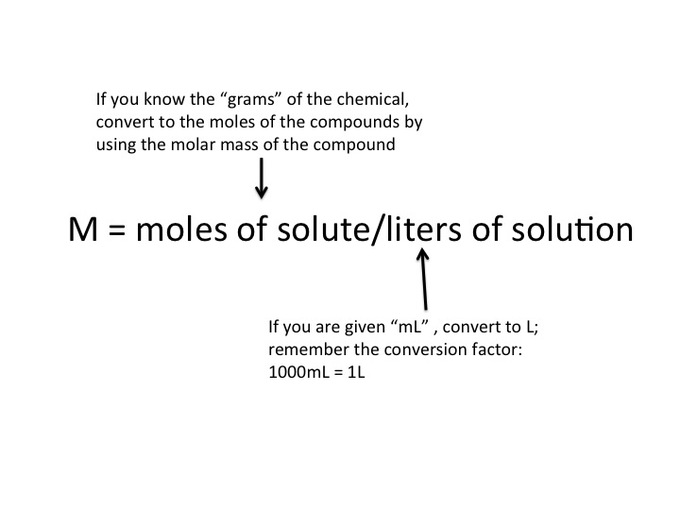
Molarity: Molarity is a measurement of concentration, with units of mol solute per liter solution.
Using Molarity in Calculations Involving Solutions
Molarity can be used in a various calculations involving solutions. The following formula is very useful, as it relates the molarity of the solution, the total volume of the solution (in liters), and the number of moles solute:
[latex]\text{MV}=\text{mol}[/latex]
Example i
A student pipettes a 100 mL sample of a 1.5 M solution of potassium bromide. How many moles of potassium bromide are independent in the sample?
[latex]\text{MV}=\text{mol}[/latex]
(1.five Chiliad)(0.100 L) = mol
mol = 0.15 mol KBr
Notice in the instance higher up that volume must be converted to L from mL.
You might notice that the in a higher place formula bears some resemblance to our dilution formula:
[latex]\text{K}_1\text{V}_1=\text{M}_2\text{Five}_2[/latex]
Because we at present know that MV = mol, nosotros can simplify our the dilution formula to the following:
[latex]\text{mol}_1=\text{mol}_2[/latex]
This shouldn't surprise usa. After all, in any dilution, what changes is the amount of solvent, while the number of moles of solute remains constant throughout.
Example two
What is the molarity of a solution containing 0.32 moles of NaCl in 3.4 liters of solution?
[latex]\text{Thou}=\frac{0.32\text{ mol NaCl}}{iii.iv\text{ L solution}}={0.094\text{ M NaCl}}[/latex]
Solution Stoichiometry
Stoichiometry can be used to summate the quantitative relationships between species in aqueous solution.
Learning Objectives
Calculate concentrations of solutions in molarity, molality, mole fraction and percent by mass and book.
Key Takeaways
Fundamental Points
- Stoichiometry deals with the relative quantities of reactants and products in chemical reactions. It can exist used to detect the quantities of the products from given reactants in a balanced chemic reaction, as well as percent yield.
- To calculate the quantity of a product, summate the number of moles for each reactant. Moles of a product are equal to the moles of a limiting reactant in one-to-one reaction stoichiometry. To detect product mass, moles must be multiplied by the product'due south molecular weight.
- In stoichiometric calculations involving solutions, a given solution's concentration is often used as a conversion factor.
Central Terms
- stoichiometry: the written report and calculation of quantitative (measurable) relationships of the reactants and products in chemical reactions (chemic equations)
- molarity: the concentration of a substance in solution, expressed as the number moles of solute per liter of solution
- molality: the concentration of a substance in solution, expressed every bit the number of moles of solute per kilogram of solvent
Concentration of Solutions
Retrieve that a solution consists of two components: solute (the dissolved material) and solvent (the liquid in which the solute is dissolved). The amount of solute in a given corporeality of solution or solvent is known every bit the concentration. The ii most common means of expressing concentration are molarity and molality.
Molarity
The molar concentration (1000) of a solution is divers as the number of moles of solute (north) per liter of solution (i.east, the volume, Vsolution):
[latex]\text{M}=\frac{\text{n}}{\text{V}_{\text{solution}}}[/latex]
The units of molarity are mol/L, frequently abbreviated as Yard.
For example, the number of moles of NaCl in 0.123L of a one.00M solution of NaCl can be calculated as follows:
[latex]0.123\text{ L of solution} \times \frac{ane.00 \text{ mole}}{1.00 \text{ L of solution}} = 0.123 \text { moles NaCl}[/latex]
Molality
The molal concentration (thou) of a solution is defined equally the number of moles of solute (due north) per kilogram of solvent (i.e., the mass of the solvent, msolvent):
[latex]\text{m}=\frac{\text{n}}{\text{m}_{\text{solvent}}}[/latex]
The units of molality are mol/kg, or m.
For case, the number of moles of NaCl dissolved in 0.123kg of HiiO (the solvent), in guild to make a 1.00m solution of NaCl, tin can be calculated every bit follows:
[latex]0.123 \text{ kg of solvent} \times \frac{1.00 \text{ mole}}{i.00 \text{ kg of solvent}} = 0.123 \text { moles NaCl}[/latex]
Reaction Stoichiometry in Solutions
Nosotros can perform stoichiometric calculations for aqueous phase reactions simply every bit we can for reactions in solid, liquid, or gas phases. Almost always, we will utilise the concentrations of the solutions equally conversion factors in our calculations.
Case
- 123 mL of a i.00 M solution of NaCl is mixed with 72.5 mL of a 2.71 M solution of AgNO3. What is the mass of AgCl(southward) formed in the precipitation reaction?
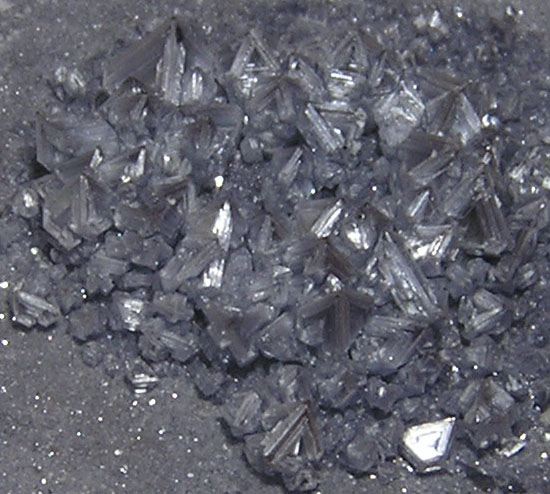
Crystals of argent chloride (AgCl): Stoichiometry deals with the relative quantities of reactants and products in chemical reactions. It tin exist used to observe the quantities of the products from given reactants in a balanced chemical reaction, equally well as percent yield.
First, nosotros need to write out our balanced reaction equation:
[latex]\text{AgNO}_3(aq)+\text{NaCl}(aq)\rightarrow\text{AgCl}(s)+\text{NaNO}_3(aq)[/latex]
The adjacent stride, as in any adding involving stoichiometry, is to determine our limiting reactant. We tin do this by converting both of our reactants into moles:
[latex]\text{123 mL NaCl}\times \frac{\text{one Fifty}}{\text{1000 mL}} \times \frac{\text{1.00 mol NaCl}}{\text{1 Fifty}}= \text{0.123 mol NaCl}[/latex]
[latex]\text{72.5 mL AgNO}_3 \times \frac{\text{i L}}{\text{1000 mL}} \times \frac{\text{ii.71 mol AgNO}_3}{\text{i L}}= \text{0.196 mol AgNO}_3[/latex]
We can see from our reaction equation that AgNO3 and NaCl react in a one:one ratio. Because at that place are fewer moles of NaCl present in solution, NaCl is our limiting reactant. We can now solve for the mass of AgCl formed:
[latex]\text{123 mL NaCl} \times \frac{\text{1 L}}{\text{1000 mL}} \times \frac{\text{1.00 mol NaCl}}{\text{one L}} \times \frac {\text{1 mol AgCl}}{\text{1 mol NaCl}} \times \frac {\text{143 thou}}{\text{1 mol AgCl}}=\text{17.6 yard AgCl}[/latex]
Therefore, 17.6 g AgCl(s) is formed in the reaction.
To sum upward: nosotros converted to each reactant'south moles by using the given concentrations as conversion factors, expressing molarity as mol/L; in one case we found our limiting reactant, we converted through to grams of AgCl formed.
Source: https://courses.lumenlearning.com/boundless-chemistry/chapter/solution-concentration/

Post a Comment for "How to Know the Concentration of a Solution You Are Making"