O Lost and by the Wind Grieved Ghost Come Back Again
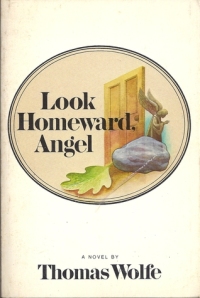
My wife and I just returned from Due north Carolina, where nosotros toured the Thomas Wolfe House in Asheville. The museum occupies the sprawling, many-gabled boarding house his mother in one case ran for visitors (many of them tuberculosis patients) seeking the cool mountain air. Wolfe memorialized the house as "Dixieland" in his deeply autobiographical start novel Look Homeward, Angel.

The real "Dixieland" (Photo: Wikipedia)
Our guide said that fewer and fewer people coming for the tour have read Thomas Wolfe. This surprised and saddened me. When I read Wait Homeward, Angel in my late teens, I marveled at the effusive Whitmanesque linguistic communication—more poesy than prose—that energized every page. Certain scenes, in particular his blood brother's expiry, are so vivid and sorry, they tin however bring tears to my eyes.
Wolfe begins Look Homeward, Angel with a prose poem that echoes once more and again in the 500-folio book:
…a stone, a leaf, an unfound door; of a rock, a leaf, a door. And of all the forgotten faces.
Naked and alone we came into exile. In her dark womb we did not know our mother's confront; from the prison of her flesh have nosotros come into the unspeakable and impossible prison of this earth.
Which of us has known his brother? Which of us has looked into his father's heart? Which of u.s.a. has not remained forever prison-pent? Which of us is not forever a stranger and alone?
O waste product of loss, in the hot mazes, lost, among the vivid stars on this most weary unbright cinder, lost! Remembering speechlessly we seek the not bad forgotten language, the lost lane-terminate into sky, a rock, a leaf, an unfound door. Where? When?
O lost, and by the wind grieved, ghost, come back again.
 In rhapsodic prose Thomas Wolfe captured the voracious youthful yearning of coming of age in an isolated Southern boondocks at the turn of the 20thursday Century, the tug and tussle of a large fractious family struggling to make ends run into, the lonesome whistle of a belatedly-dark train heading into the vast world beyond the encircling hills, the odor of coffee and the gustation of pancakes in a diner amid the drowsy conversation of tired newspapermen as the morning edition arrives with the beginning rays of the sun. The honey and hunger of it all, etched upon the memory, unforgettable and lost.
Wolfe has been compared to Marcel Proust in his struggle to capture the detailed essence of his life. He loved the vast all-encompassing embrace of Walt Whitman'south poetry, but he equally admired the innovations of James Joyce's Ulysses, which manage to compress a earth into a day. Wolfe's own uniquely American style, so profuse and personal, would influence Jack Kerouac, Ray Bradbury and Pat Conroy. Faulkner said he might have proven to exist the best writer of his generation had he lived.
The story of Wolfe's discovery by Scribners editor Maxwell Perkins is i of fable. Perkins, who had discovered F. Scott Fitzgerald and launched the career of Ernest Hemingway, became a surrogate begetter to Wolfe. The towering half dozen-foot-vi Due north Carolinian, who sometimes wrote standing upward using the top of his refrigerator equally his desktop, arrived in New York and famously delivered an 1100-page loose-leaf showtime draft to Scribners. Over 330,000 words! With Perkins' editing, it became Look Homeward, Angel, a volume as sprawling as the boarding house Wolfe grew upwards in.
Considering of the novel's autobiographical nature (it included some 200 characters drawn from family, friends and Ashville citizens, and not all favorably), Wolfe dared not return to Asheville for 8 years after its publication. He traveled to Europe and wrote Of Fourth dimension and the River, an even bigger novel that continued where Expect Homeward, Angel left off. Information technology became a bestseller, although information technology is a less powerful story than Angel.
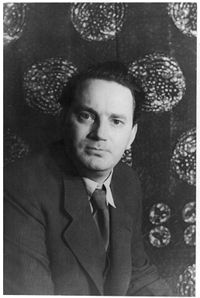
Thomas Wolfe (Photo: Wikipedia)
Critics began to say it was Perkins, not Wolfe, who was the genius behind the books (reminiscent of what people would say sixty years later nearly Raymond Carver and his editor, Gordon Lish). To prove himself, Wolfe broke with Scribners and went to Harper Brothers, where he basically wrote the same books over over again in You Can't Go Habitation Once again, The Web and the Rock and The Hills Beyond, all published after his death in 1938, just shy of his 38th birthday. (According to our guide, Wolfe was on a ferry from Seattle going to British Columbia when he shared a flask of whiskey with some other passenger. Wolfe subsequently contracted flu, so pneumonia, which in plow exacerbated miliary tuberculosis probably acquired as a boy in his mother's boarding house. Neurosurgury sent him into a coma from which he never recovered.)
Any and all of Wolfe's novels are worth reading if just for those sections where his prose soars. Only for those without the stamina for the novels, some of his finest writing can be found in his volume of stories, From Death to Forenoon, which includes the superlative and experimental novella, The Spider web of Earth, almost the nativity of his twin brothers.
My sadness to hear that Wolfe is read less today was lightened by our splendid guide. He left us with some hopeful news and the prediction that Wolfe's books would achieve a new generation. A film based on the prize-winning biography Max Perkins: Editor of Genius by A. Scott Berg, most the stormy relationship betwixt Perkins and Wolfe, is being filmed and scheduled for release in 2015. Titled Genius, information technology stars Colin Firth as Perkins and Jude Law every bit Wolfe. Perhaps a ghost, a great one, can come back once again.
Source: https://tomgething.wordpress.com/2014/05/04/o-lost-and-by-the-wind-grieved-ghost-come-back-again/

Post a Comment for "O Lost and by the Wind Grieved Ghost Come Back Again"